Category

Thoughts in Focus

Category

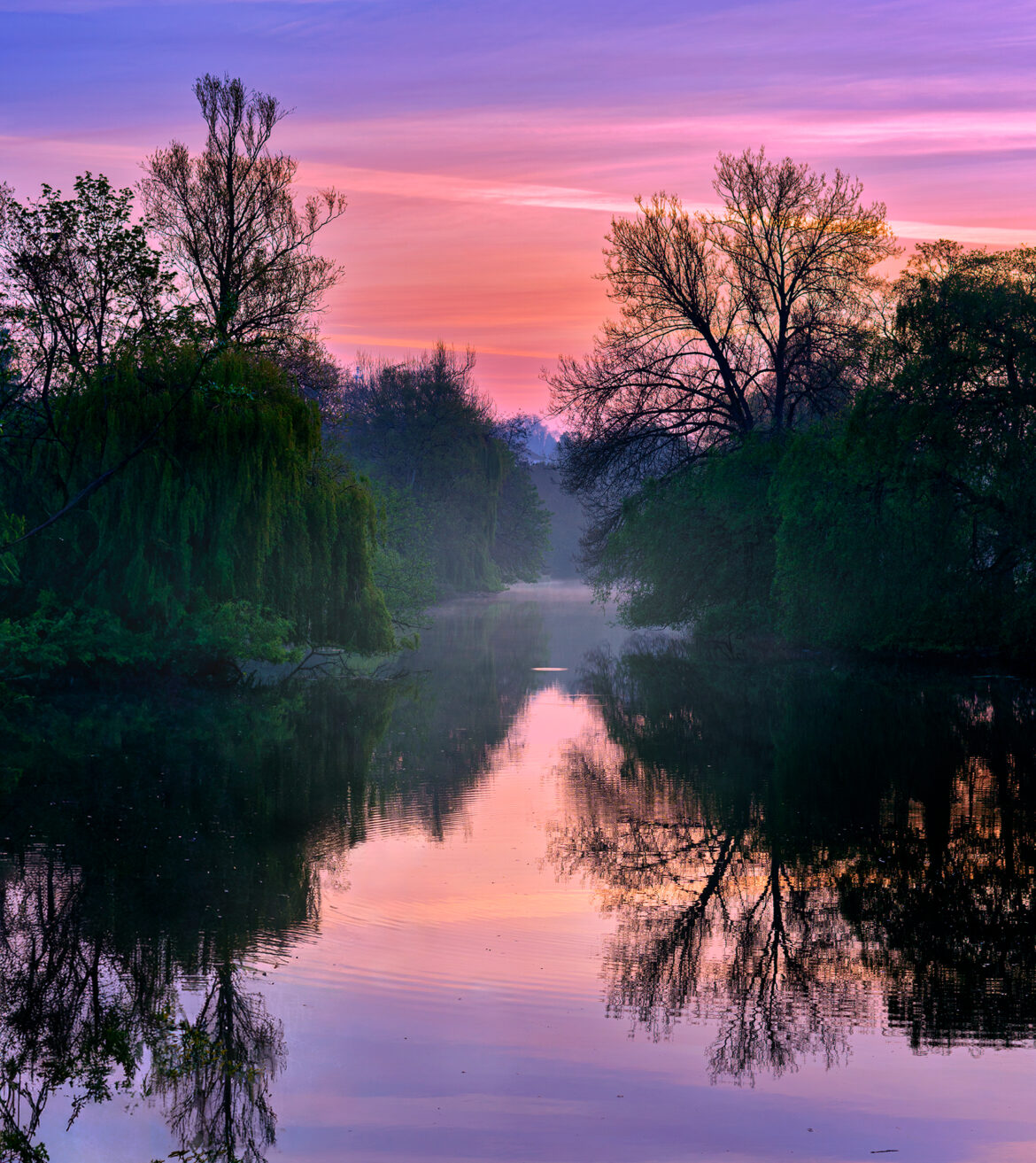
I am drawn to the places where the world grows quiet. The river at dusk, the hush before night settles over the land, the trembling reflection of sky on water— these are the moments that call to me,and the moments I return to again and again. My work begins there, in that soft borderland between seeing and feeling, where landscape becomes something more than a scene and begins to feel like memory.

I have always been moved by the way light changes a place. The same bank, the same stretch of water, the same horizon can become entirely different under the surrender of evening light. Twilight has a language of its own — tender, fleeting, almost secretive — and I am always trying to listen. It is in those fading colours, those lengthening shadows, those almost-silent transitions, that I find the deepest poetry of a place.

What I seek in my work is not just appearance, but atmosphere. Not only the visible world, but the emotional weather that lives inside it. A river can carry stillness and motion at once. A shoreline can hold solitude without emptiness. A sky can become a veil for feeling. I am interested in these in-between spaces, these fragile thresholds where the ordinary becomes luminous simply by being seen with care.

For me, landscape is never neutral. It is intimate. It gathers the traces of our passing, the weight of memory, the comfort of return. Certain places seem to stay with us long after we have left them, as if they have quietly entered the interior life. I think my work is, in many ways, an attempt to give shape to that feeling — to hold onto what cannot quite be held, to make visible the tenderness of a moment before it disappears.

There is something deeply human in the act of paying attention. To stand before a river, a field, a fading sky, and truly look is, for me, an act of reverence. It is a way of slowing the world down, if only for a breath. I want my work to offer that same pause to others — a place to rest the eye, to breathe more deeply, to remember what it feels like to be still.

At its heart, my art is an offering to quiet beauty. It is a way of noticing what is easily missed, of gathering fragments of light, of preserving the delicate and passing things that move us before they vanish. In the end, I am not trying to describe the world so much as to listen to it — and to translate something of its softness, its mystery, and its fleeting grace.
I am text block. Click edit button to change this text. Lorem ipsum dolor sit amet, consectetur adipiscing elit. Ut elit tellus, luctus nec ullamcorper mattis, pulvinar dapibus leo.I am text block. Click edit button to change this text. Lorem ipsum dolor sit amet, consectetur adipiscing elit. Ut elit tellus, luctus nec ullamcorper mattis, pulvinar dapibus leo.I am text block. Click edit button to change this text. Lorem ipsum dolor sit amet, consectetur adipiscing elit. Ut elit tellus, luctus nec ullamcorper mattis, pulvinar dapibus leo.

The Rhythm of Light:

An Interview with Brian Roe

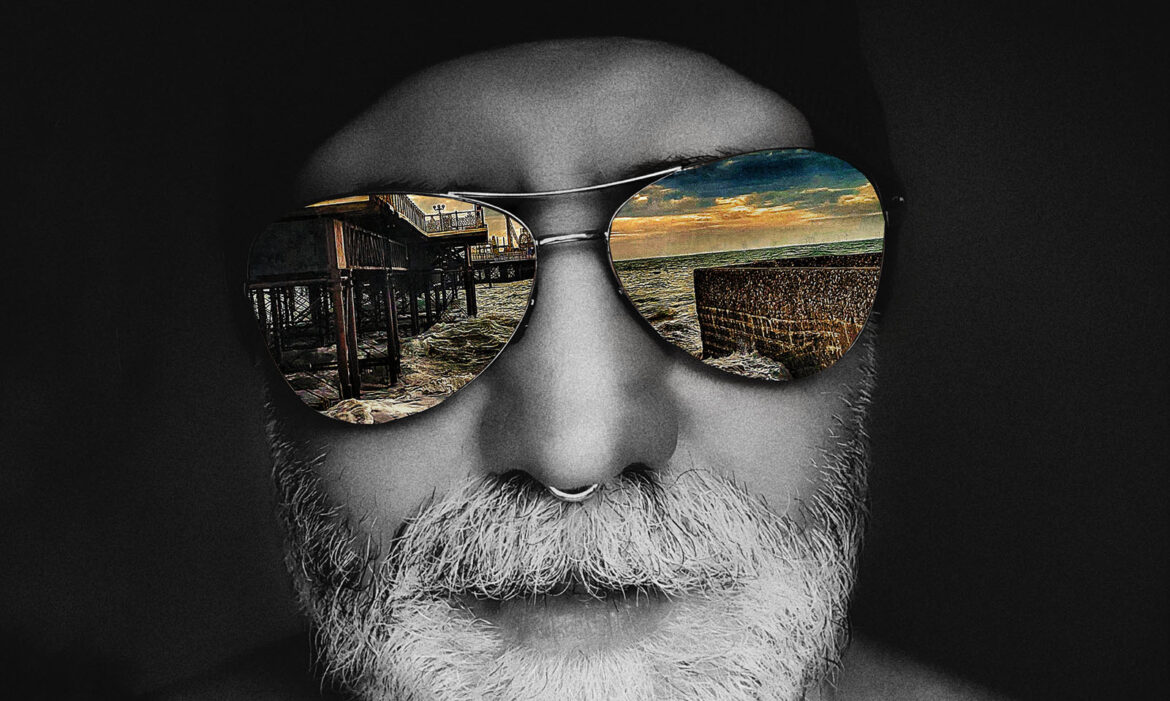
PG: Most people know you today for your ethereal, atmospheric photography. What they might not realise is that your “eye” was forged through forty years of immersion in music, art, and the bleeding edge of technology. Could you trace the line for us—how does a student of fine art end up a pioneer of hardcore punk, and eventually, a digital artist?

BR: If I had to summarise it, I’d say I’m a student of the Old Masters who got sidetracked by a drum kit and a punk-rock revolution. I went from the structured world of art college to the hedonistic chaos of life on the road as a teenage drummer. Eventually, I traded the drumsticks for the early tools of interactive technology, exploring the “new frontier” of web design and digital art. Decades later, that same teenage excitement hits me every time I start a new piece. It’s the same energy; I just have a better handle on the “mixer” now.

The Musical Journey

The Varuker Days

PG: We’re big fans of using technology to push artistic boundaries, but we have to pause on the “teenage punk drummer” part. That’s a hell of a prologue.

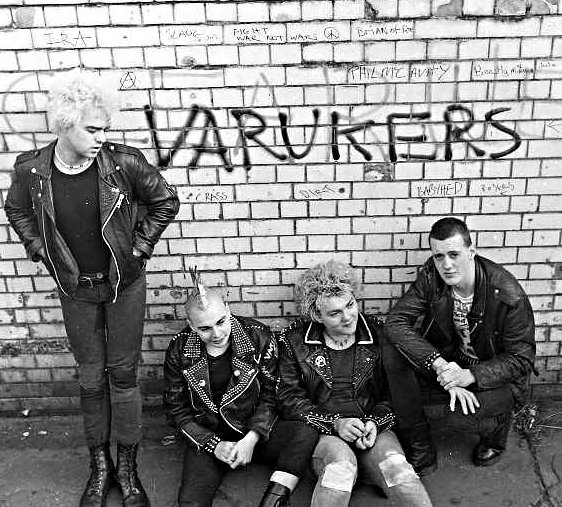
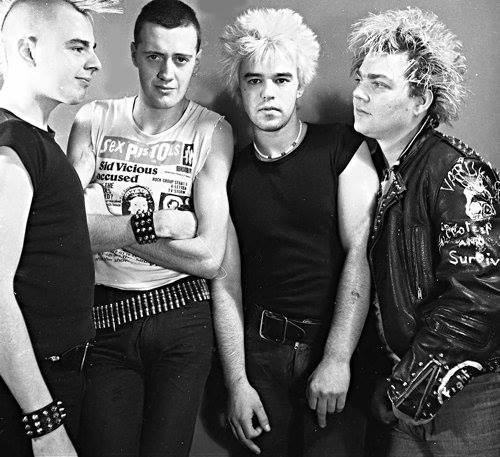
BR: It was a whirlwind. I was the drummer for The Varukers, joining straight out of school in Leamington Spa. We weren’t just playing music; we were pioneering a sound. Between touring and recording, we landed three singles in the Indie Top 5 and our debut album, Bloodsuckers, hit Number 1. This put The Varukers on the map globally as one of the pioneers and iconic hardcore punk bands of the ’80s.

Brighton & The Road to London

BR: I moved to Brighton in 1987, worked on the Palace Pier selling sunglasses in the day and played the drums in the evening. I toured with Transvision Vamp and New Model Army. By the early 90s, I worked with a few goth bands, including Sunshot and Kula Shaker. My last big tour of the ’90s was with the iconic punk band X-Ray Spex. It was fun while it lasted, but my liver is much happier with me now!

Education and Influence

Art College

PG: You mentioned Art College earlier. How did you balance the fine art world with the rock-and-roll schedule?

BR: I took the opportunity when I wasn’t touring to study photography as part of a YTS scheme in the early 80s, where I learnt all fundamentals of photography—”dark room” magic, developing negatives, and enlarger printing. After the YTS scheme, I went on to art college where I studied Fine Art, History of Art and 3D design in Ceramics.

Joe Teti

BR: A big influence on my creative education was Joe Teti. Joe was a fellow drummer, and he mentored me from age 17 to 20. He taught me about the fundamentals of great art: texture, form, mass, the golden ratio, and how the eye is contained. Today, my work is at the cutting edge of design technology based on a solid foundation of classical art education.

Defining Art

PG: Given that background, how do you actually define “Art”?

BR: Art is the manifestation of spiritual and emotional thoughts and feelings. After my time as a professional drummer ended, I spent some years as a digital nomad in Bali, India, and Sri Lanka. I immersed myself in the culture and spirituality of these places, and this is something I expressed through my work.

Philosophy and Environment

Environment & Sustainability

PG: How have the places you’ve lived in and visited shaped your art?

BR: As young punk rockers, we were always more environmentally aware than our parents. I have seen the beauty of the world, and unfortunately, I have also seen that beauty ruined by supermarket plastic bags washing up on the beach. Sustainability is very important to me; photography highlights what we stand to lose if we don’t take action now.

The Emotional Connection

PG: How would you describe your art to someone who has never seen it?

BR: Each and every composition I do has a story to tell and a deep connection to me. I want to share the energy I am getting from a composition and hopefully evoke similar feelings from the viewer. It’s like a busman’s holiday—I enjoy playing with my own photos for my own enjoyment, and then I want to share them.

The Digital Surrealist

PG: How has technology shaped the way artists express themselves over the past 20 years?

BR: Technology has enabled all photographers and artists to become surrealist painters. I often think about Salvador Dalí. He was the first ‘Photoshop’ artist… If Dali had had Photoshop, I think he would still have created masterpieces like ‘The Persistence of Memory’. Technology has made all photographers into potential Salvador Dalís.

Process and Routine

Finding Focus in the Quiet

PG: Do you have a daily routine when it comes to how you work?

BR: I wake early, around 5 am or 6 am, and start my day with a strong cup of Lavazza coffee. Early mornings are the most creative parts of the day, and I spend the first 3 or 4 hours on my work because it’s quiet and I can focus 100%. I generally find that a good night’s sleep will inspire some new ideas for the day ahead.

Final Thoughts

Captain Cook

PG: If you could be born as anyone else in history, who would it be?

BR: Captain Cook in the early 1800s. He was on a mission to explore somewhere new with just his ship, his crew, a map, and a telescope. I would love to do the equivalent with my camera and motorbike—explore new places and take beautiful photos.

PG: What is one thing people are always surprised to find out about you?

BR: People are usually surprised that I was a drummer for a famous punk band and helped create the ‘D-beat’ style of drumming, or that I was the drummer with the original Kula Shaker when the band started.

PG: One book you’d recommend?

BR: ‘Awaken the Giant Within’ by Tony Robbins. It acted as a graphic equaliser for my life—the musicians out there will know what I mean!

An Interview with Brian Roe was conducted by Pixel Gallery.

Explore my latest Ethereal Gallery Prints or Digital Art Downloads

Pin It