Category

Thoughts

Category

Why New Tools Never Kill Old Souls
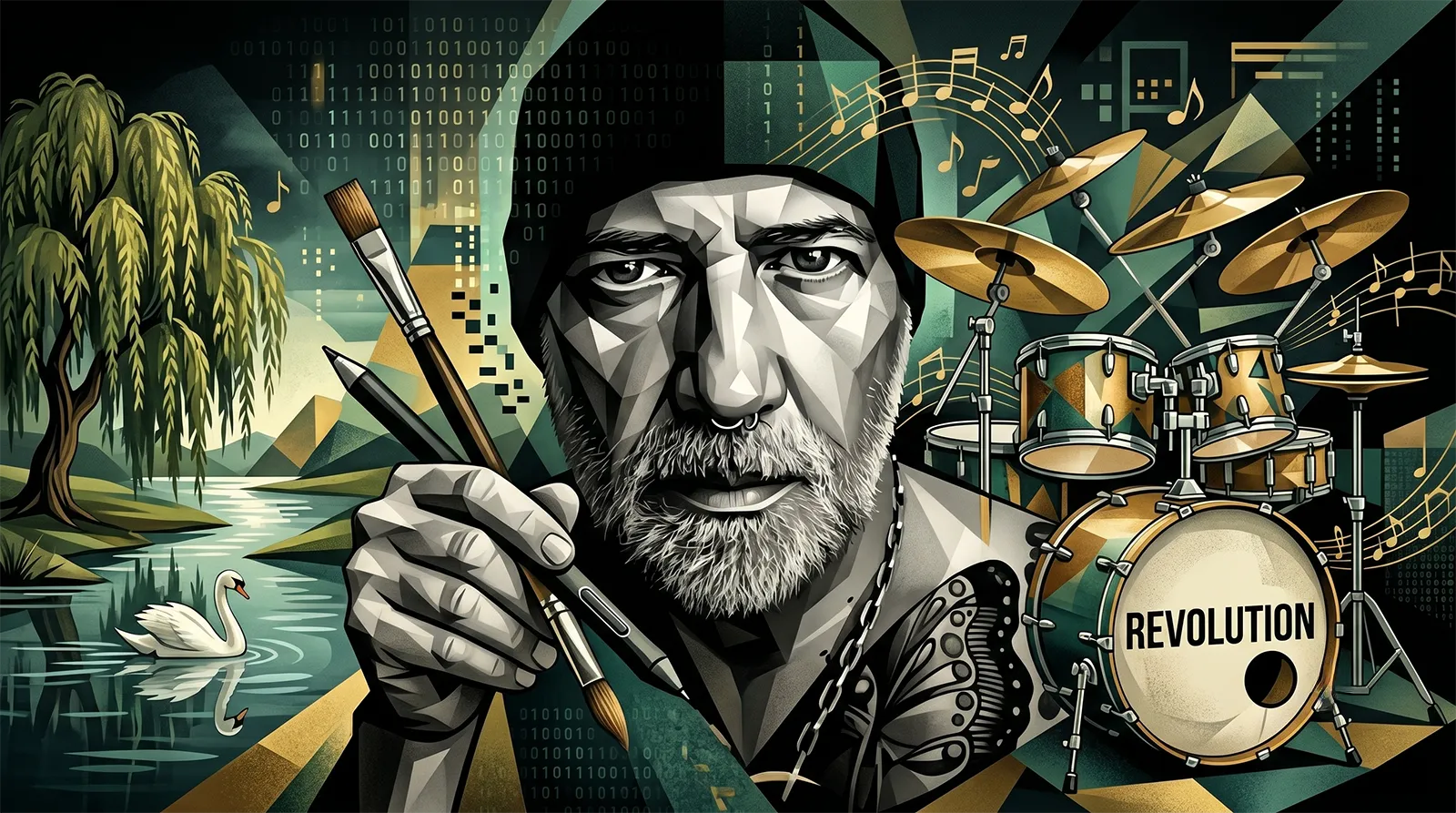
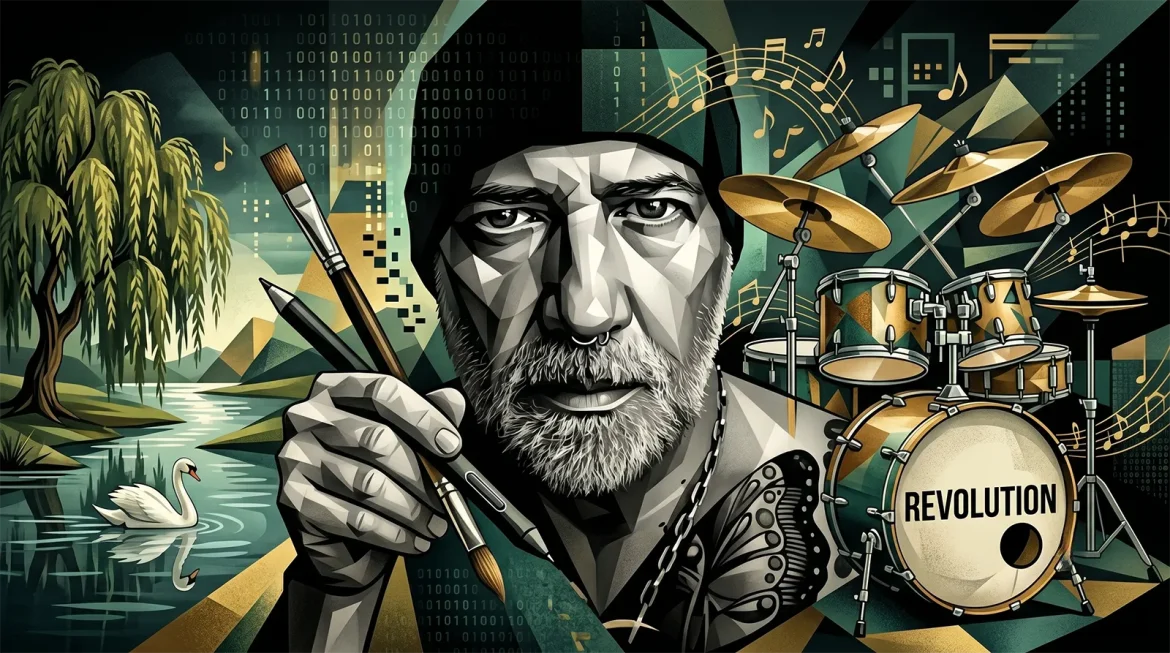
A contemporary cubist-abstract fine art collage. A central self-portrait of artist Brian Roe with intense eyes, a septum ring, silver chain, and a butterfly shoulder tattoo, set against a dark void with integrated geometric forms. On the right, a detailed, complex drum kit is meticulously woven into the cubist geometry. Musical notes swirl around the composition. A hand holds both a traditional paintbrush and a modern digital stylus. On the left, a weeping willow and serene river scene with a swan and its reflection from image_0.png are subtly integrated. The background features glowing fragmented binary code and digital patterns, symbolizing the continuation of soul through new tools.

The Evolution of the Canvas: Why New Technology Never Kills Art


Every time humanity invents a new way to create, the gatekeepers of culture go into an absolute panic.
Right now, the art world is up in arms about the rise of modern digital tools, complex software, and Artificial Intelligence. If you listen to the loudest voices in the galleries, they’ll tell you that the machines are coming to strip the soul out of creativity, that algorithms are replacing artists, and that true craftsmanship is dead. They treat tech like a terminal illness.
Personally? I think they’re terrified of change.

When I sit in my studio at dawn, I don’t feel diminished by modern technology. I don’t feel less creative. I feel an intoxicating explosion of new possibilities.

The 19th-Century Panic

To understand why people are so frightened today, you only have to look back at the late 19th century. When the first commercial cameras emerged, traditional oil painters were absolutely furious. They claimed that a mechanical box capturing light with chemistry was a soulless, cheap shortcut. They argued that it wasn’t “real” art because the machine did the heavy lifting.

But history proved them completely wrong. The camera didn’t kill painting; it liberated it.

Once painters were freed from the tedious chore of accurately documenting reality for portraits and landscapes, they were forced to innovate. The camera gave birth to Impressionism, Surrealism, and Abstract art. It forced artists to paint how a moment felt, rather than just how it looked. The tool changed, the perspective shifted, and the art world exploded into its most vibrant era.

Decades later, the same battle was fought when digital photography began to overtake film and the darkroom. The traditionalists wept for the loss of chemical negatives, claiming digital sensors lacked “warmth” and “soul.” Today, nobody questions the artistic validity of a digital lens. We embraced the evolution, and we loved the results.

The Ghost in the Drum Machine

We see the exact same pattern in the history of music. The journey from classical orchestral arrangements and acoustic pianos to the electric guitar was met with horror by the traditional establishment. Jazz was called noise. Rock and roll was called a threat to culture.

And then came the 1980s, the era of the synthesiser and the electronic drum machine.

As a young punk drummer, I remember the anxiety surrounding those little plastic boxes with their programmed rhythms. The headlines screamed that the drum machine would make human drummers obsolete. But it didn’t.

Instead, the drum machine forced us to evolve. It birthed entirely new genres of electronic music, synth-pop, and hip-hop. It didn’t replace human groove; it became a collaborator. Drummers didn’t vanish—we just learned to play with the machine, absorbing its mathematical precision into our own physical energy. The human spirit simply adapted to the new canvas.
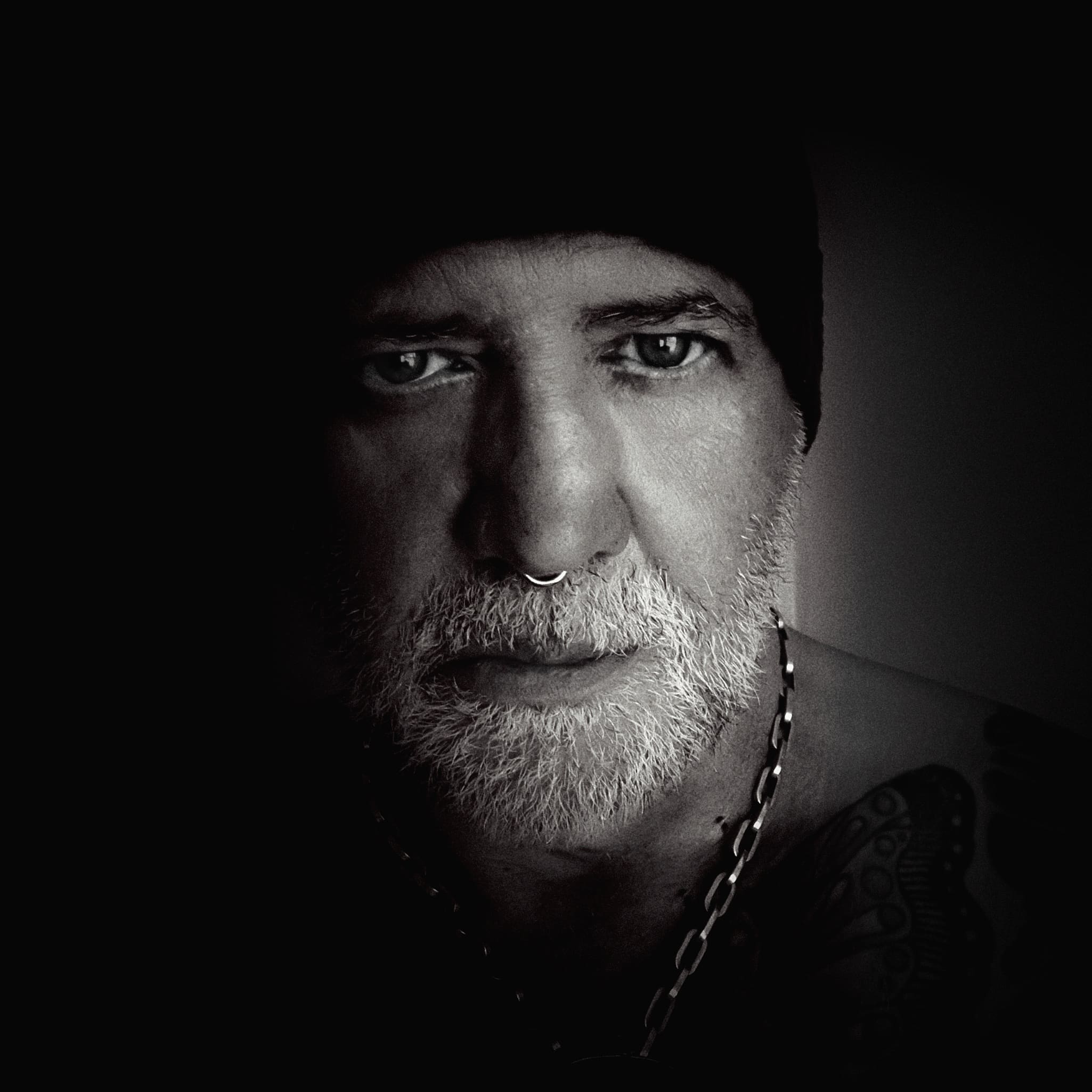
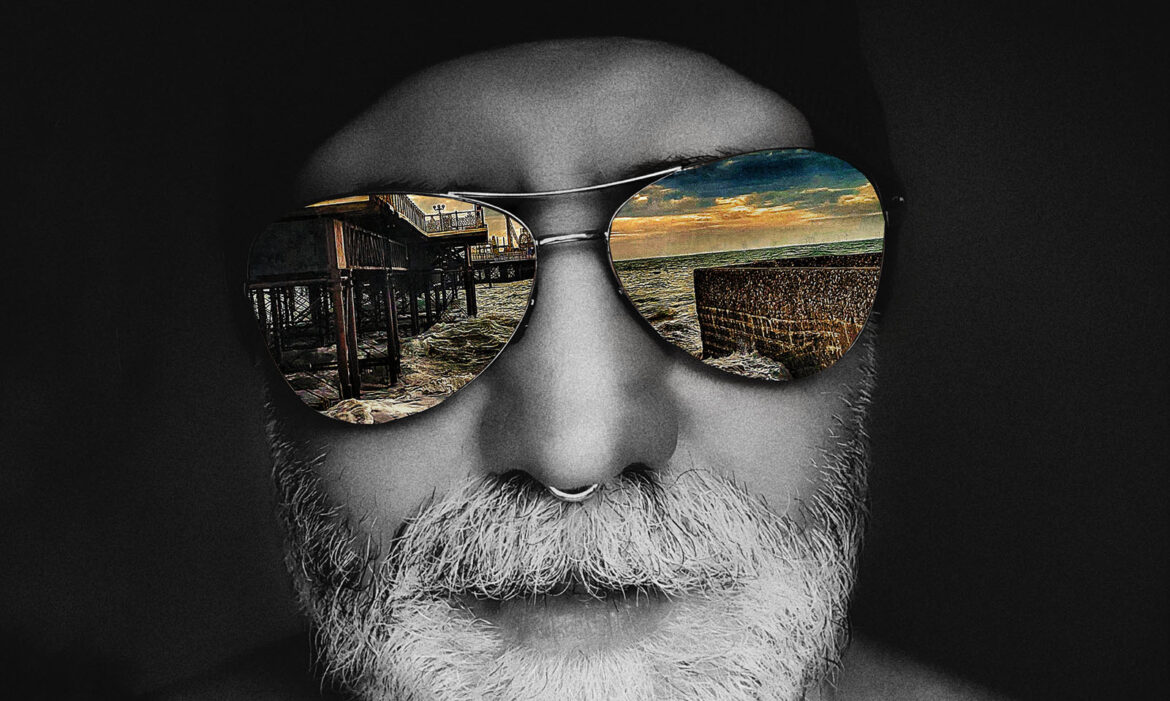
Brian Roe Self Portrait in Black and White

More Possibilities, Not Less

I cut my teeth classically. At art college, I learnt how to stretch canvases, mix oil paints, and sculpt raw clay with my bare hands. I know the physical weight of traditional mediums.

But today, my canvas is digital, and my brushes are found in Photoshop. Does that make the hours I spend composing an image any less spiritual? Does it mean the emotional resonance of a finished print is artificial? Not a chance.

Whether you are using a chisel, an oil brush, a camera lens, or an AI prompt, the tool is completely neutral. A computer cannot feel joy. An algorithm cannot experience the grief of a shared memory, the awe of a Brighton sunset, or the working-class struggle of a lifetime. The machine has no gut instinct. It has no soul to pour into the work.

Modern inventions don’t replace the artist; they expand the horizon. They give those of us with stories to tell a larger, faster, more versatile vocabulary.

I’m not interested in hiding from the future or romanticising the limitations of the past. I am using every single cutting-edge tool available to bring my creative vision to life. The tools will keep evolving, people will keep panicking, but the human need to connect through art will always remain completely untouchable.
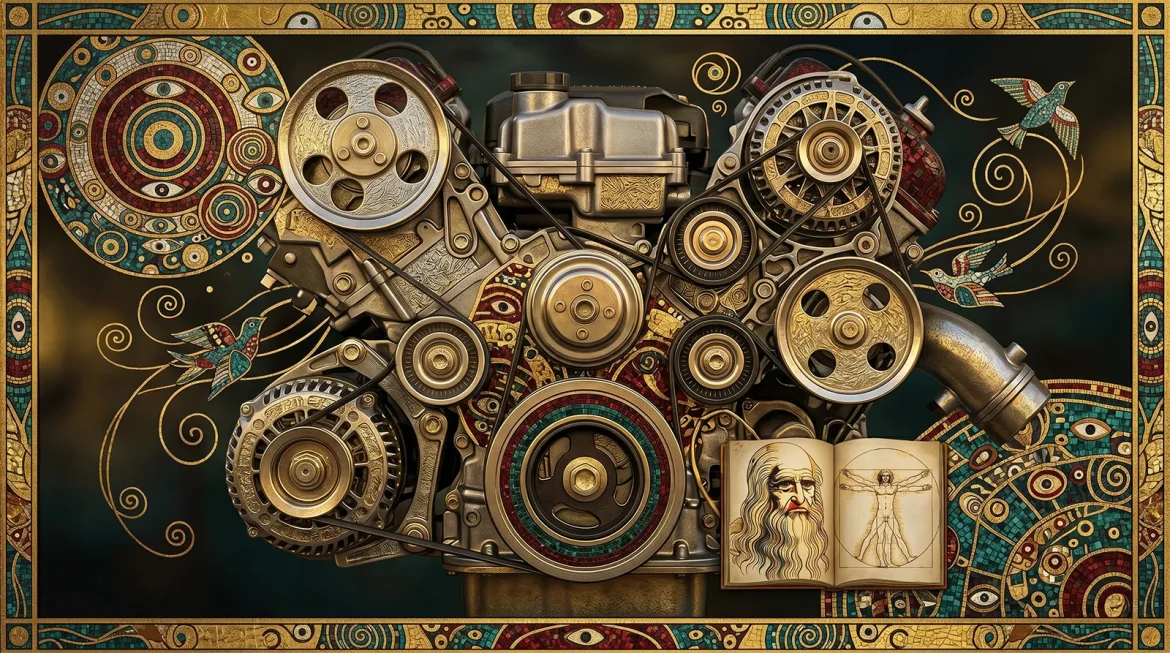
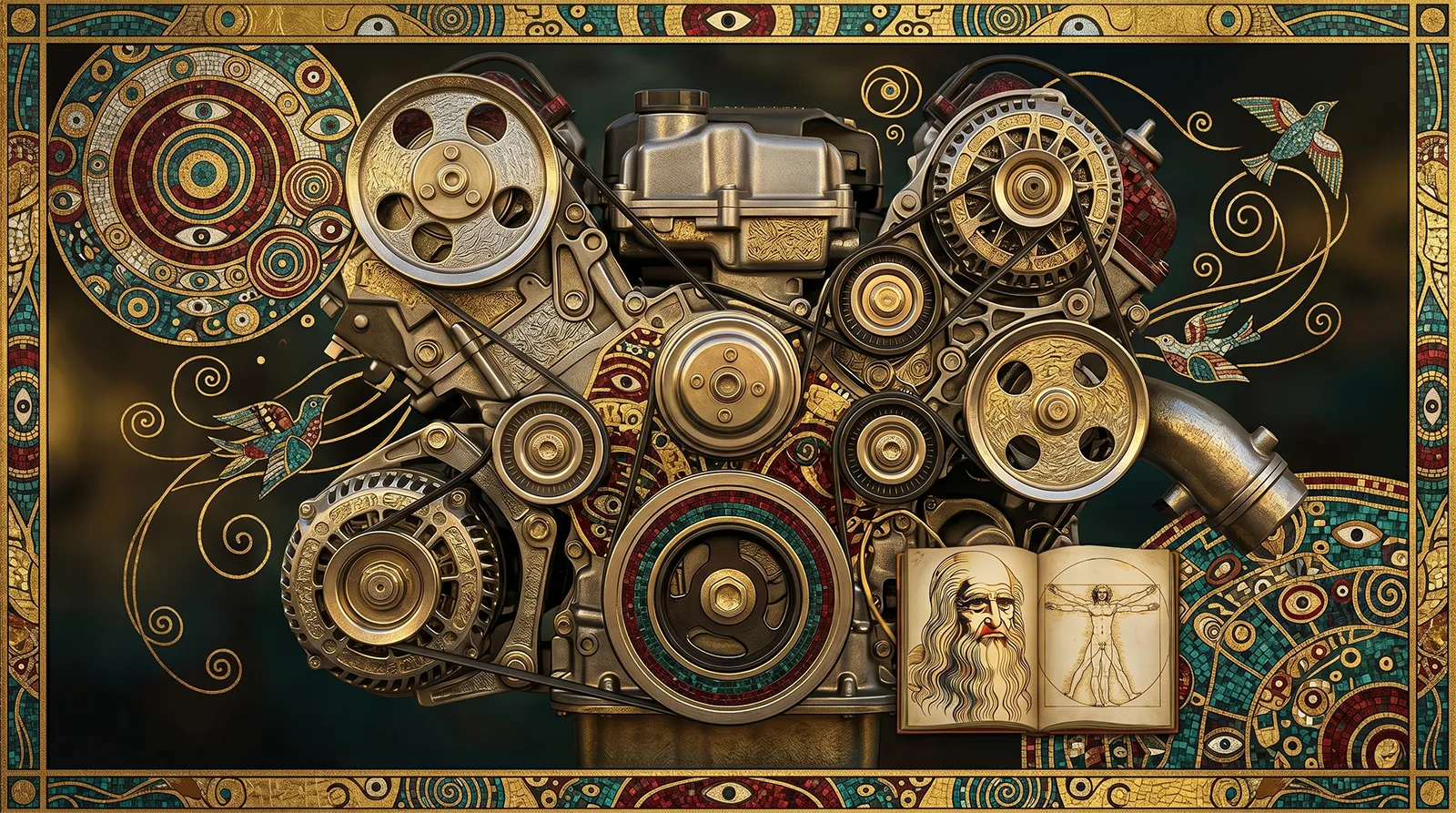
Sticks, Pixels, and the Golden Ratio

A fine art composition titled Sticks, Pixels, and the Golden Ratio by Brian Roe, blending a mechanical engine block with gold leaf mosaic art in the style of Gustav Klimt, featuring an open notebook with Leonardo da Vinci sketches.

We live in a world that desperately wants us to pick a lane and stay in it.

If you walk into an ’80s art college, you’re expected to be at the bleeding edge of the counterculture—breathing in alternative ideas, arguing about Dadaism, and using the studio spaces to question everything. If you sit behind a drum kit pioneering a savage hardcore punk D-beat, you’re supposed to keep that energy raw, loud, and restricted to sweaty basement venues. And if you spend twenty years in web design, you’re supposed to trade that rebellion for the corporate matrix—worshipping grid structures, code, and the cold efficiency of the internet.

Society loves to tell us that working-class lads from the Midlands are built for the factory floor, the trade, or the steady, predictable grind. If we get creative, we’re allowed to play loud music, but we aren’t supposed to claim a stake in the high-end world of fine art. That space is usually reserved for people with different accents and expensive degrees.

I know this because I lived all three. But for a long time, I wondered how on earth a lad born in Leamington Spa, who spent his youth hammering a snare drum, was supposed to reconcile that chaotic energy with the classical principles of the Old Masters and the cold discipline of a computer screen.

It took me forty years to realise that I hadn’t been changing careers at all. I’d just been changing the tools.


The Rhythm of the Lens

When people look at my print, when a thousand wings whisper love—thousands of starlings forming a heart silhouette over the Brighton Palace Pier at dusk—they often comment on the composition. They talk about the balance, the timing, the way the eye is contained within the frame.

I smile and thank them, but in my head, I’m thinking about Joe Teti.

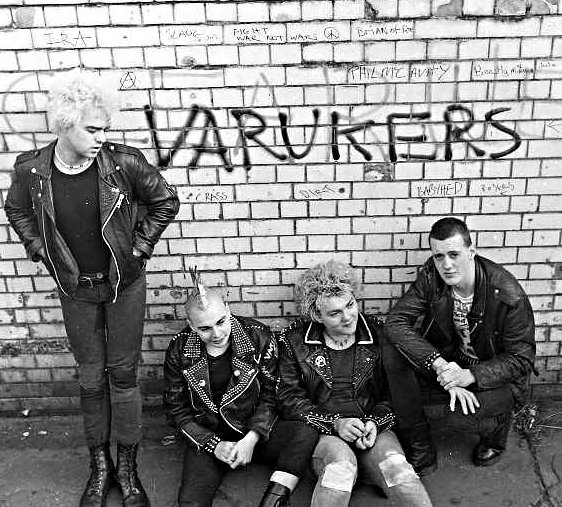
Joe was my drum mentor when I was seventeen. He didn’t just teach me how to keep time; he taught me about texture, form, mass, and the spaces between the noise. When I left school and jumped straight into the whirlwind of drumming for The Varukers, landing a Number 1 indie album, I wasn’t just making noise. I was learning how to command energy.

When you are playing a live punk show, or touring later with the likes of X-Ray Spex or the early iterations of Kula Shaker, you are manipulating an atmosphere. You are balancing heavy, dramatic highs against a deep, driving baseline.

Today, when I sit down at 5 AM with a brutally strong cup of Lavazza coffee to work on a fine art composition, I am doing the same thing. I’m just using digital brushes instead of drumsticks. I’m balancing the heavy, dramatic gold of a Leamington sky against the resting verdigris of a riverbank. I’m adjusting the “mixer” of light and shadow.

Music is a beautiful, fleeting ghost—the moment the amplifiers cut out, the sound vanishes into the air. But a visual composition stands still. It remains on the wall, holding its breath, waiting to connect with whoever walks into the room.


The Salvador Dalí of the Screen

There is a strange misconception that digital art is somehow “sterile” or “disconnected.” People look at the tech and mistake it for a shortcut, assuming the machine does the feeling for you. But technology hasn’t replaced craftsmanship; it has unlocked it.

In the late ’80s, after the whirlwind of the road, I found myself in Brighton. By day, I was selling sunglasses on the Palace Pier, soaking in that bohemian, sea-salted light; by night, I was still playing. But as the ’90s rolled in, a new frontier opened up: interactive technology and web design.

Web design is brutal. It’s a world of strict grid structures, user interfaces, and technical constraints. It forces you to understand exactly how a viewer navigates a visual space. For over two decades, I immersed myself in that bleeding edge of design tech. My career in web design wasn’t a detour from art—it was my digital apprenticeship. It gave me the technical mastery to turn the machine into an extension of my own hands.

A funny thing happens when you give an artist a computer. You realise that technology has essentially turned all of us into potential surrealists. I often think about Salvador Dalí. He is widely considered a master of traditional oil painting, but at his core, Dalí was an investigator of the subconscious mind. He took ordinary, disparate elements and warped them to expose a deeper, psychological truth.

If Dalí had possessed Photoshop in the 1930s, do you honestly think he would have turned his nose up at it? Not a chance. He would have been sitting at a screen at dawn, completely obsessed with the ability to manipulate light, shadow, and scale to a microscopic degree. Technology gives us the power to paint with reality itself.


A Truly Rich Life

Coming from a background where nothing was handed to me, I learned early on that creativity is a discipline, not a hobby. The resilience required to survive the chaos of the road is the same stamina needed to sit at a screen for fourteen hours, manually weaving hundreds of digital layers together until a flat digital photograph takes on a three-dimensional soul.

After the music faded and the commercial web design world became too loud, I packed a bag and spent years as a digital nomad in India, Sri Lanka, and Bali. I needed to strip away the literal. I needed to quiet the ego and connect with something permanent.

I have seen people make themselves terminally ill chasing corporate titles, luxury cars, and the illusion of big money. It’s a game that just doesn’t interest me. I’ve never wanted to be rich in paper; I want a rich life.

A rich life means having the freedom to earn from your passion rather than punching a clock to sell your time. It means using a lifetime of shared experiences—the joy, the grit, the travel, and the obstacles of class and education—and melting them down into an image that hits someone right in the emotional solar plexus.

When you look at the deep verdigris tones and golden horizons in my prints, you aren’t looking at a commercial product. You are looking at a working-class rebel who traded his drumsticks for digital brushes, refused to stay in his lane, and finally found peace in the quiet space of dawn.

Focusing on Local Roots & Geography

While this piece explores the digital transition through mechanical grit, my creative process remains deeply anchored in the local landscapes of Warwickshire, much like the structural inspiration found nearby at The Mill Bridge in Leamington Spa.

The Rhythm of Light:

An Interview with Brian Roe

PG: Most people know you today for your ethereal, atmospheric photography. What they might not realise is that your “eye” was forged through forty years of immersion in music, art, and the bleeding edge of technology. Could you trace the line for us—how does a student of fine art end up a pioneer of hardcore punk, and eventually, a digital artist?

BR: If I had to summarise it, I’d say I’m a student of the Old Masters who got sidetracked by a drum kit and a punk-rock revolution. I went from the structured world of art college to the hedonistic chaos of life on the road as a teenage drummer. Eventually, I traded the drumsticks for the early tools of interactive technology, exploring the “new frontier” of web design and digital art. Decades later, that same teenage excitement hits me every time I start a new piece. It’s the same energy; I just have a better handle on the “mixer” now.

The Musical Journey

The Varuker Days

PG: We’re big fans of using technology to push artistic boundaries, but we have to pause on the “teenage punk drummer” part. That’s a hell of a prologue.

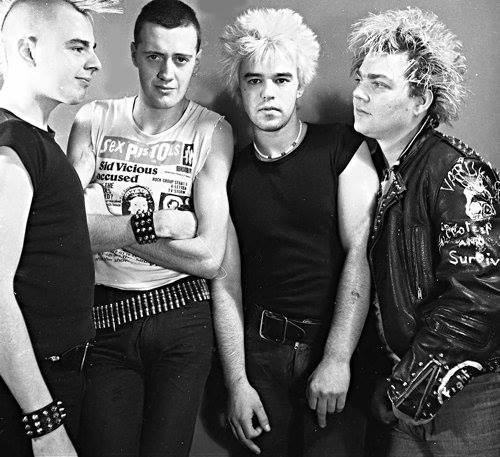
BR: It was a whirlwind. I was the drummer for The Varukers, joining straight out of school in Leamington Spa. We weren’t just playing music; we were pioneering a sound. Between touring and recording, we landed three singles in the Indie Top 5 and our debut album, Bloodsuckers, hit Number 1. This put The Varukers on the map globally as one of the pioneers and iconic hardcore punk bands of the ’80s.

Brighton & The Road to London

BR: I moved to Brighton in 1987, worked on the Palace Pier selling sunglasses in the day and played the drums in the evening. I toured with Transvision Vamp and New Model Army. By the early 90s, I worked with a few goth bands, including Sunshot and Kula Shaker. My last big tour of the ’90s was with the iconic punk band X-Ray Spex. It was fun while it lasted, but my liver is much happier with me now!

Education and Influence

Art College

PG: You mentioned Art College earlier. How did you balance the fine art world with the rock-and-roll schedule?

BR: I took the opportunity when I wasn’t touring to study photography as part of a YTS scheme in the early 80s, where I learnt all fundamentals of photography—”dark room” magic, developing negatives, and enlarger printing. After the YTS scheme, I went on to art college where I studied Fine Art, History of Art and 3D design in Ceramics.

Joe Teti

BR: A big influence on my creative education was Joe Teti. Joe was a fellow drummer, and he mentored me from age 17 to 20. He taught me about the fundamentals of great art: texture, form, mass, the golden ratio, and how the eye is contained. Today, my work is at the cutting edge of design technology based on a solid foundation of classical art education.

Defining Art

PG: Given that background, how do you actually define “Art”?

BR: Art is the manifestation of spiritual and emotional thoughts and feelings. After my time as a professional drummer ended, I spent some years as a digital nomad in Bali, India, and Sri Lanka. I immersed myself in the culture and spirituality of these places, and this is something I expressed through my work.

Philosophy and Environment

Environment & Sustainability

PG: How have the places you’ve lived in and visited shaped your art?

BR: As young punk rockers, we were always more environmentally aware than our parents. I have seen the beauty of the world, and unfortunately, I have also seen that beauty ruined by supermarket plastic bags washing up on the beach. Sustainability is very important to me; photography highlights what we stand to lose if we don’t take action now.

The Emotional Connection

PG: How would you describe your art to someone who has never seen it?

BR: Each and every composition I do has a story to tell and a deep connection to me. I want to share the energy I am getting from a composition and hopefully evoke similar feelings from the viewer. It’s like a busman’s holiday—I enjoy playing with my own photos for my own enjoyment, and then I want to share them.

The Digital Surrealist

PG: How has technology shaped the way artists express themselves over the past 20 years?

BR: Technology has enabled all photographers and artists to become surrealist painters. I often think about Salvador Dalí. He was the first ‘Photoshop’ artist… If Dali had had Photoshop, I think he would still have created masterpieces like ‘The Persistence of Memory’. Technology has made all photographers into potential Salvador Dalís.

Process and Routine

Finding Focus in the Quiet

PG: Do you have a daily routine when it comes to how you work?

BR: I wake early, around 5 am or 6 am, and start my day with a strong cup of Lavazza coffee. Early mornings are the most creative parts of the day, and I spend the first 3 or 4 hours on my work because it’s quiet and I can focus 100%. I generally find that a good night’s sleep will inspire some new ideas for the day ahead.

Final Thoughts

Captain Cook

PG: If you could be born as anyone else in history, who would it be?

BR: Captain Cook in the early 1800s. He was on a mission to explore somewhere new with just his ship, his crew, a map, and a telescope. I would love to do the equivalent with my camera and motorbike—explore new places and take beautiful photos.

PG: What is one thing people are always surprised to find out about you?

BR: People are usually surprised that I was a drummer for a famous punk band and helped create the ‘D-beat’ style of drumming, or that I was the drummer with the original Kula Shaker when the band started.

PG: One book you’d recommend?

BR: ‘Awaken the Giant Within’ by Tony Robbins. It acted as a graphic equaliser for my life—the musicians out there will know what I mean!

An Interview with Brian Roe was conducted by Pixel Gallery.

Explore my latest Ethereal Gallery Prints or Digital Art Downloads

Pin It