
Sticks, Pixels, and the Golden Ratio
We live in a world that desperately wants us to pick a lane and stay in it.
If you walk into an ’80s art college, you’re expected to be at the bleeding edge of the counterculture—breathing in alternative ideas, arguing about Dadaism, and using the studio spaces to question everything. If you sit behind a drum kit pioneering a savage hardcore punk D-beat, you’re supposed to keep that energy raw, loud, and restricted to sweaty basement venues. And if you spend twenty years in web design, you’re supposed to trade that rebellion for the corporate matrix—worshipping grid structures, code, and the cold efficiency of the internet.
Society loves to tell us that working-class lads from the Midlands are built for the factory floor, the trade, or the steady, predictable grind. If we get creative, we’re allowed to play loud music, but we aren’t supposed to claim a stake in the high-end world of fine art. That space is usually reserved for people with different accents and expensive degrees.
I know this because I lived all three. But for a long time, I wondered how on earth a lad born in Leamington Spa, who spent his youth hammering a snare drum, was supposed to reconcile that chaotic energy with the classical principles of the Old Masters and the cold discipline of a computer screen.
It took me forty years to realise that I hadn’t been changing careers at all. I’d just been changing the tools.
The Rhythm of the Lens
When people look at my print, when a thousand wings whisper love—thousands of starlings forming a heart silhouette over the Brighton Palace Pier at dusk—they often comment on the composition. They talk about the balance, the timing, the way the eye is contained within the frame.
I smile and thank them, but in my head, I’m thinking about Joe Teti.
Joe was my drum mentor when I was seventeen. He didn’t just teach me how to keep time; he taught me about texture, form, mass, and the spaces between the noise. When I left school and jumped straight into the whirlwind of drumming for The Varukers, landing a Number 1 indie album, I wasn’t just making noise. I was learning how to command energy.
When you are playing a live punk show, or touring later with the likes of X-Ray Spex or the early iterations of Kula Shaker, you are manipulating an atmosphere. You are balancing heavy, dramatic highs against a deep, driving baseline.
Today, when I sit down at 5 AM with a brutally strong cup of Lavazza coffee to work on a fine art composition, I am doing the same thing. I’m just using digital brushes instead of drumsticks. I’m balancing the heavy, dramatic gold of a Leamington sky against the resting verdigris of a riverbank. I’m adjusting the “mixer” of light and shadow.
Music is a beautiful, fleeting ghost—the moment the amplifiers cut out, the sound vanishes into the air. But a visual composition stands still. It remains on the wall, holding its breath, waiting to connect with whoever walks into the room.
The Salvador Dalí of the Screen
There is a strange misconception that digital art is somehow “sterile” or “disconnected.” People look at the tech and mistake it for a shortcut, assuming the machine does the feeling for you. But technology hasn’t replaced craftsmanship; it has unlocked it.
In the late ’80s, after the whirlwind of the road, I found myself in Brighton. By day, I was selling sunglasses on the Palace Pier, soaking in that bohemian, sea-salted light; by night, I was still playing. But as the ’90s rolled in, a new frontier opened up: interactive technology and web design.
Web design is brutal. It’s a world of strict grid structures, user interfaces, and technical constraints. It forces you to understand exactly how a viewer navigates a visual space. For over two decades, I immersed myself in that bleeding edge of design tech. My career in web design wasn’t a detour from art—it was my digital apprenticeship. It gave me the technical mastery to turn the machine into an extension of my own hands.
A funny thing happens when you give an artist a computer. You realise that technology has essentially turned all of us into potential surrealists. I often think about Salvador Dalí. He is widely considered a master of traditional oil painting, but at his core, Dalí was an investigator of the subconscious mind. He took ordinary, disparate elements and warped them to expose a deeper, psychological truth.
If Dalí had possessed Photoshop in the 1930s, do you honestly think he would have turned his nose up at it? Not a chance. He would have been sitting at a screen at dawn, completely obsessed with the ability to manipulate light, shadow, and scale to a microscopic degree. Technology gives us the power to paint with reality itself.
A Truly Rich Life
Coming from a background where nothing was handed to me, I learned early on that creativity is a discipline, not a hobby. The resilience required to survive the chaos of the road is the same stamina needed to sit at a screen for fourteen hours, manually weaving hundreds of digital layers together until a flat digital photograph takes on a three-dimensional soul.
After the music faded and the commercial web design world became too loud, I packed a bag and spent years as a digital nomad in India, Sri Lanka, and Bali. I needed to strip away the literal. I needed to quiet the ego and connect with something permanent.
I have seen people make themselves terminally ill chasing corporate titles, luxury cars, and the illusion of big money. It’s a game that just doesn’t interest me. I’ve never wanted to be rich in paper; I want a rich life.
A rich life means having the freedom to earn from your passion rather than punching a clock to sell your time. It means using a lifetime of shared experiences—the joy, the grit, the travel, and the obstacles of class and education—and melting them down into an image that hits someone right in the emotional solar plexus.
When you look at the deep verdigris tones and golden horizons in my prints, you aren’t looking at a commercial product. You are looking at a working-class rebel who traded his drumsticks for digital brushes, refused to stay in his lane, and finally found peace in the quiet space of dawn.
Focusing on Local Roots & Geography
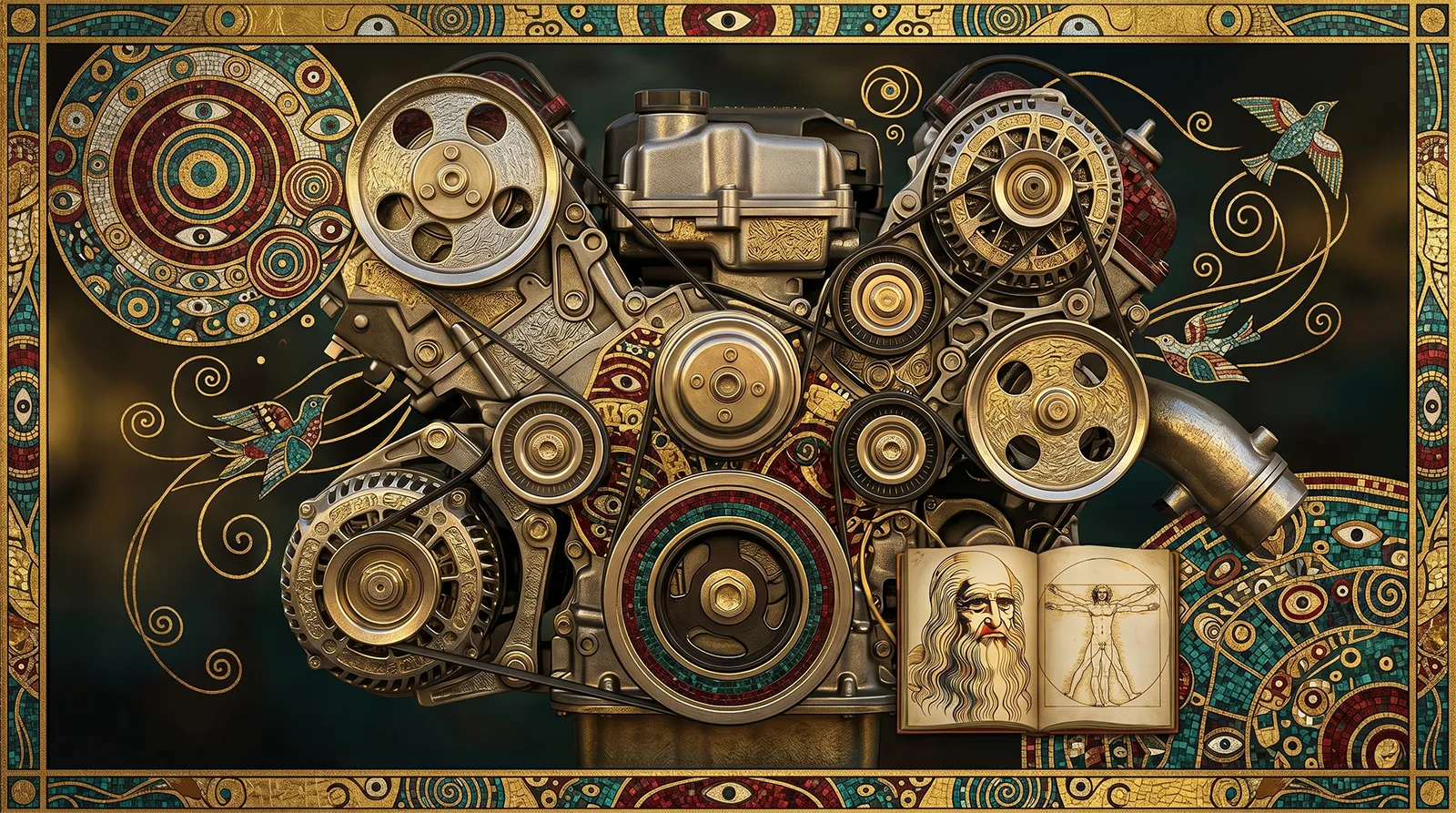
While this piece explores the digital transition through mechanical grit, my creative process remains deeply anchored in the local landscapes of Warwickshire, much like the structural inspiration found nearby at The Mill Bridge in Leamington Spa.
Comments are closed.